
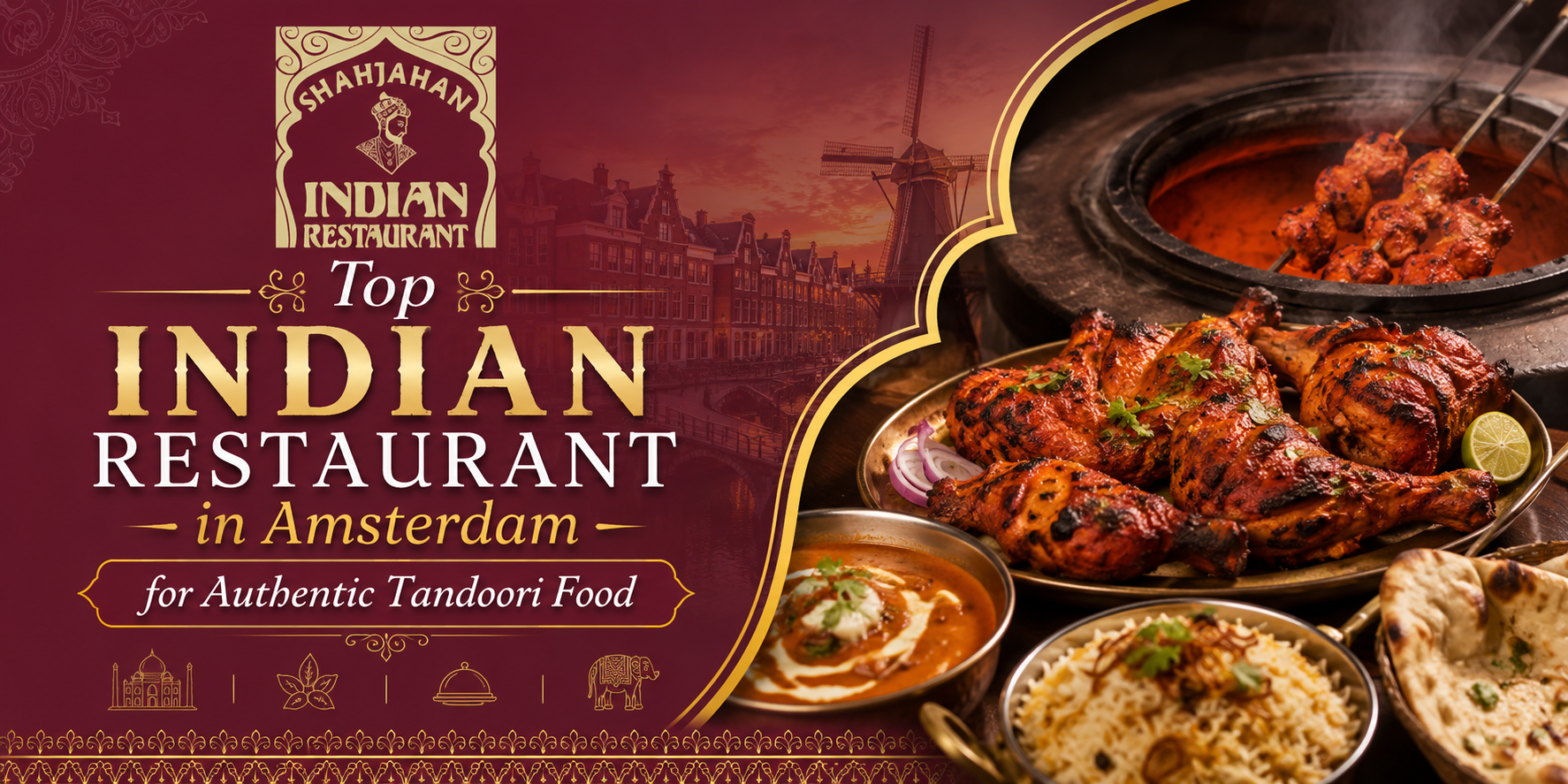
Amsterdam’s food scene is a beautiful mess of influences — Dutch classics, Surinamese roti shops, Indonesian rijsttafel, and tucked between the canals, a growing collection of Indian kitchens serving everything from quick takeaway curries to full tandoori feasts.
If you’ve ever typed “indian food close to me” into your phone while walking down Nieuwmarkt at 8pm, you know the struggle. There’s plenty of Indian food in Amsterdam. Finding the good stuff — the kind where the tandoor is actually hot, the spices are ground fresh, and the naan comes out blistered and puffed — takes a bit more knowing.
This guide covers where to eat Indian food in Amsterdam, starting with our top pick.
- Shah Jahan — The Best Indian Restaurant in Amsterdam
Shah Jahan has built its reputation on doing one thing exceptionally well: cooking real North Indian food the way it’s meant to be cooked. No shortcuts, no watereddown “European palate” adjustments unless you ask for them.
The Tandoor Is the Heart of the Kitchen
A proper tandoor runs somewhere between 400–480°C. That intense, dry heat is what gives tandoori chicken its charedged smokiness and keeps the meat unexpectedly juicy inside. It’s also why naan cooks in ninety seconds and comes out with those signature bubbled, slightly blackened spots.
At Shah Jahan, the tandoor isn’t a gimmick — it’s the centre of the operation. The chicken is marinated overnight in yoghurt, ginger, garlic, and a house spice blend, then skewered and lowered into the clay oven to order.
Standouts from the tandoori section:
- Tandoori Chicken — the benchmark dish. Charred, smoky, tender.
- Chicken Tikka — boneless, marinated, and grilled until the edges caramelise.
- Seekh Kebab — minced lamb, handshaped onto skewers, heavy on fresh coriander and green chilli.
- Tandoori Prawns — often overlooked, always worth ordering.
- Paneer Tikka — the vegetarian option that vegetarians actually get excited about.
Beyond the Tandoor
The curry menu is where the kitchen’s depth shows. Butter Chicken made with tandooricooked chicken (as it should be) folded into a tomato and cream gravy. Lamb Rogan Josh with the slowcooked richness of a proper Kashmiri braise. Dal Makhani simmered long enough that the lentils turn silky. Palak Paneer that tastes of spinach rather than just cream.
The biryani deserves its own mention — layered, aromatic, and cooked with whole spices rather than powder.
Why It Works
- Real spice levels. Order mild, medium, or hot and get exactly that.
- Strong vegetarian and vegan range. Not an afterthought section.
- Halal options available.
- Dinein, takeaway, and delivery across central Amsterdam.
- Warm, unfussy service. You’re treated like a guest, not a table number.
If you’re searching for a tandoori restaurant in Amsterdam where the clay oven does the talking, this is the one to book.
- Ashoka
One of the more established Indian names in Amsterdam, Ashoka has been feeding the city long enough to have built genuine regulars rather than just passing trade.
What to expect: A wide menu that stretches across both North and South India — so alongside the expected tikka masala and korma, you’ll find dosas and idli. That breadth is unusual in Amsterdam, where most kitchens stay firmly Punjabi.
Order: The thali is good value and a smart way to sample several dishes at once. The lamb dishes are consistently better than the chicken.
Good for: Groups, mixed preference tables, and anyone who wants South Indian options without travelling to another city.
Worth knowing: Portions are generous. Order less than you think you need.
- Bombay Inn
A Leidseplein institution and probably the most famous budget Indian in Amsterdam. It’s small, often full, and entirely unbothered about decor.
What to expect: Fast, cheap, filling. This is not a place for a leisurely twohour dinner. It’s a place to eat well for very little money and get on with your evening.
Order: The set menus are the whole point — you get a starter, main, rice, and naan for less than most places charge for a curry alone.
Good for: Students, prenightout eating, solo diners, and anyone watching their budget.
Worth knowing: Cashfriendly, queueprone, and worth going early or late to avoid the rush.
- KohiNoor
Sitting near the canal belt, KohiNoor is one of the older Indian restaurants in the city and it wears that history openly — traditional decor, classic menu, no attempt at reinvention.
What to expect: The full curryhouse experience as it existed twenty years ago, executed with consistency. Tablecloths, attentive service, familiar dishes.
Order: Rogan josh and the lamb biryani. The classics are what this kitchen does best.
Good for: Older diners, tourists who want comfort and familiarity, and anyone nostalgic for a traditional Indian restaurant atmosphere.
Worth knowing: Prices sit higher than the budget options — you’re partly paying for the canaladjacent location.
- Namaskar
Namaskar takes a more contemporary approach and reaches beyond India proper, with Nepalese dishes sharing the menu.
What to expect: A lighter, slightly more modern room than the traditional curry houses, and a menu that includes momos, Nepalesestyle curries, and Himalayan spicing alongside standard Indian fare.
Order: The momos are the reason to come. Nepalese dishes generally use less cream and more tomato and timur pepper, which makes for a noticeably different flavour profile.
Good for: Diners who’ve done the standard Indian circuit and want something adjacent but different.
Worth knowing: Nepalese spicing tends to be sharper and less rich than Punjabi — worth knowing before you order.
- Ganesha
A neighbourhood restaurant with a loyal local following rather than a tourist one, which usually says good things about the food.
What to expect: Unpretentious, straightforward Indian cooking. No theatre, no concept, just a kitchen that turns out reliable curries night after night.
Order: The vegetarian dishes hold up well here — chana masala, aloo gobi, dal.
Good for: Regular weeknight eating, local delivery, and anyone who values consistency over novelty.
Worth knowing: Smaller space, so booking is sensible at weekends.
- Rasa Sayang
The most eclectic entry on this list — Rasa Sayang draws on both Indian and Southeast Asian traditions, which reflects Amsterdam’s own culinary history more than most Indian restaurants do.
What to expect: A menu where curries sit alongside dishes with Indonesian and Malaysian DNA. Coconut, lemongrass, and tamarind appear more often than in a straight North Indian kitchen.
Order: The dishes where the two influences meet — that’s where it’s most interesting.
Good for: Adventurous eaters, and groups who can’t agree on a cuisine.
Worth knowing: If you want strictly authentic North Indian food, this isn’t the right stop. If you want something with a bit of hybrid character, it is.
- Taj Mahal
Central, familiar, and exactly what the name suggests. Taj Mahal is the safe pick — the restaurant you choose when you want a known quantity.
What to expect: Standard curryhouse menu, executed competently. Tikka masala, korma, vindaloo, jalfrezi, the full roster.
Order: Butter chicken or chicken tikka masala. Play it straight.
Good for: Firsttime Indian diners, families with fussy eaters, and travellers who want no surprises.
Worth knowing: Central location means central prices and a heavier tourist skew.
- Sarban
A smaller, grillfocused operation that leans harder into tandoori and kebabs than most.
What to expect: Less emphasis on gravy dishes, more on skewers. Compact space, strong takeaway trade.
Order: Mixed grill platter. Seekh kebabs specifically.
Good for: Meatforward eaters, takeaway, and anyone who prefers drycooked dishes to curries.
Worth knowing: The vegetarian range is thinner here than elsewhere on this list — plan accordingly.
- New Delhi
Casual, quick, and built around the dishes everyone already knows.
What to expect: Fast service, familiar menu, reasonable prices. A functional Indian restaurant rather than a destination one.
Order: Vindaloo if you want heat, korma if you don’t. Both are competently done.
Good for: Lunch, weeknight takeaway, and lowstakes eating.
Worth knowing: Delivery is the strength here more than the dining room.
How to Spot a Genuinely Good Indian Restaurant
A few things worth checking before you commit:
Ask about the tandoor. If a restaurant advertises tandoori food but cooks it in a conventional oven, the difference is immediately obvious. Real tandoori has char. Ovenbaked chicken doesn’t.
Look at the vegetarian section. Indian cuisine has one of the richest vegetarian traditions on earth. If the veg options are three dishes long and all involve the same sauce, that tells you something.
Check the bread. Naan should arrive hot, puffed, and slightly irregular in shape. Perfectly uniform naan usually means frozen.
Notice the spice conversation. Kitchens confident in their cooking will ask how you want it. Kitchens that aren’t will default everything to mild.
Indian Food Close to Me: Amsterdam Neighbourhood Notes
- Centrum — highest concentration, most touristfacing. Quality varies wildly.
- De Pijp — a strong food neighbourhood generally, with a few good Indian options.
- OudWest — increasingly good for South Asian food, often better value than the centre.
- Zuid — fewer options, but the ones that exist tend to be more polished.
Planning Your Visit
Indian food is built for sharing. The ideal order for two people: one tandoori starter, two curries with contrasting bases (one tomato, one cream, or one dry), a dal, rice, and two breads. Add raita to cool things down and a pickle for sharpness.
Order enough to have leftovers. Indian food, almost uniquely, tastes better the next day.
Book a Table at Shah Jahan
If you want authentic tandoori cooking, honest spicing, and a kitchen that respects the tradition it comes from, Shah Jahan is where to start.
Whether you’re planning a proper sitdown dinner, ordering in, or just following a craving down a canal at midnight this is the best Indian restaurant in Amsterdam to have on your list.