
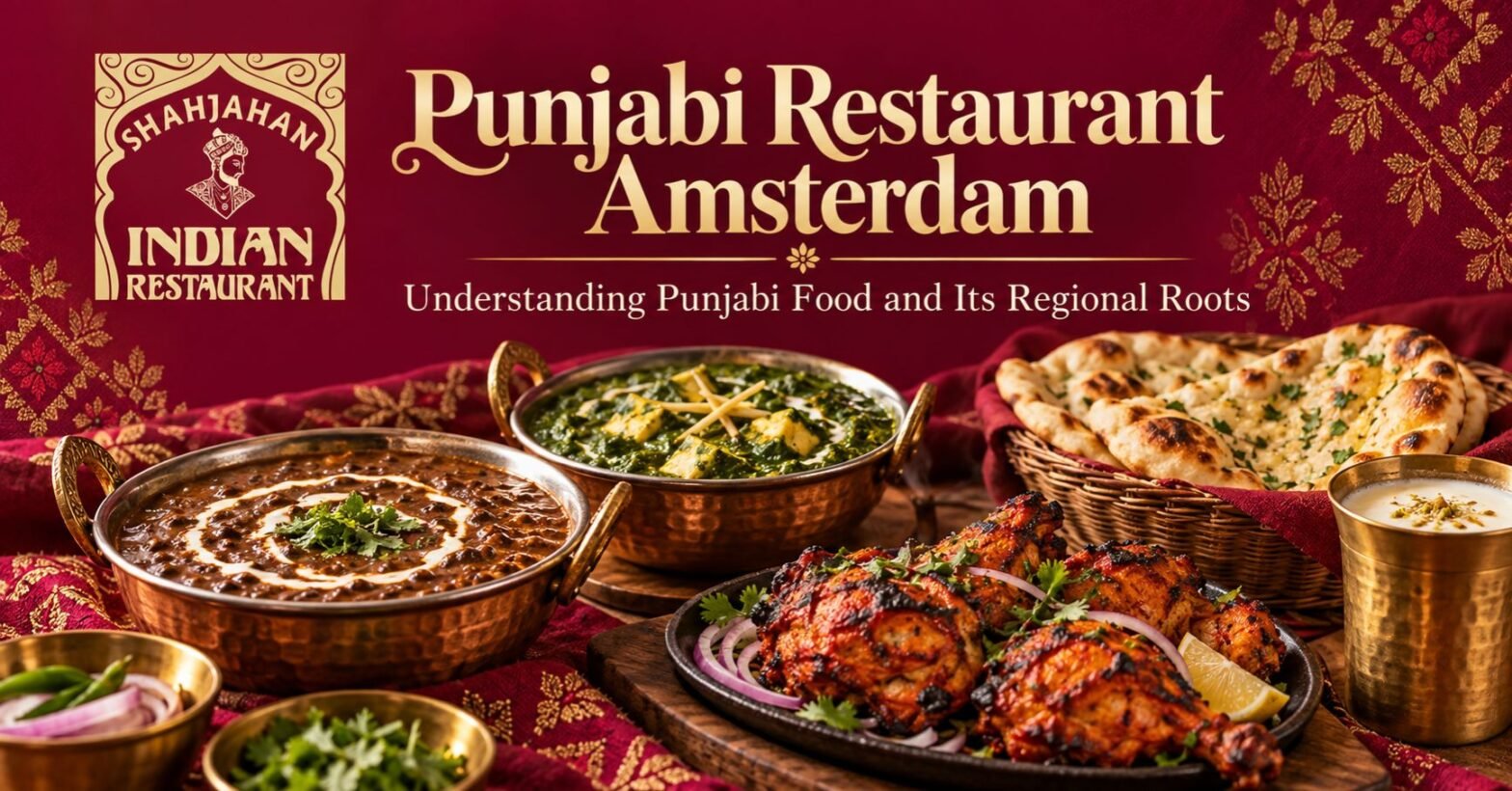
When most people in the Netherlands think of Indian food, they picture a creamy curry, a basket of warm naan and something smoky from the tandoor. What many don’t realise is that a large share of those favourites come from one specific part of South Asia: Punjab. If you have ever searched for a Punjabi restaurant in Amsterdam, it helps to know what makes this cooking different, where it comes from, and why it tastes the way it does.
In this guide we look at the land, the regions, the ingredients and the history behind Punjabi food, and then show you how those roots come to life on the plate at Pind Punjabi, just a short walk from De Pijp.
[IMAGE: Real photo of a shared Punjabi meal on a table, people’s hands reaching for naan and curry. Alt text: Punjabi food shared at a Punjabi restaurant in Amsterdam]
What “Punjabi” Really Means: The Land of Five Rivers
The word Punjab comes from Persian: panj means five and ab means water. It refers to the five rivers of the region, the Jhelum, Chenab, Ravi, Beas and Sutlej, which have fed its farmland for thousands of years. The ancient Greeks had a name for it too, Pentapotamia, which also translates as the land of five rivers.
Today Punjab is not one place on the map. When British India was divided in 1947, the region was split in two. The western half became Punjab province in Pakistan, and the eastern half became the Indian state of Punjab. According to the Government of Punjab, the region’s fertile land made it the granary of British India, and it is also the birthplace of several religious movements, including Sikhism.
That shared history matters for food. Punjabi cooking belongs to both sides of the border, which is why you will find close relatives of the same dishes in Amritsar and in Lahore.
Majha, Doaba and Malwa: The Regions Behind the Food
Indian Punjab is usually described as three broad cultural regions, each shaped by the rivers around it. As Deccan Herald explains, Majha lies between the Ravi and Beas, Doaba lies between the Beas and Sutlej, and Malwa stretches beyond the Sutlej.
Majha: The Historic Heart
Majha includes the city of Amritsar, home to the Golden Temple. This is the part of Punjab most closely linked with Sikh heritage, and Amritsar gives its name to well-known local dishes such as Amritsari kulcha, a stuffed bread often eaten with chickpeas (chhole).
Doaba: The Land Between Two Rivers
The name Doaba literally means “two waters”, a reference to its position between the Beas and Sutlej. Doaba is known for its huge overseas community, with many families settling in the UK, Canada and across Europe. That diaspora is a big reason Punjabi food is now found in cities all over the world, Amsterdam included.
Malwa: The Agricultural Powerhouse
Malwa is the largest of the three regions and has long been Punjab’s farming heartland. Its wide fields of wheat and mustard help explain why hearty breads, greens and dairy sit at the centre of so many Punjabi meals.
[IMAGE: Real photo of wheat or mustard fields in rural Punjab with farmers. Alt text: Farmland in Punjab, the region behind Punjabi cuisine]
Wheat, Dairy and Fire: The Building Blocks of Punjabi Cooking
Punjabi food grew out of a farming way of life. After the Green Revolution of the 1960s and 1970s, Punjab became known as the breadbasket of both India and Pakistan. The region is a major producer of wheat, rice and dairy, and those three ingredients shape almost everything on a Punjabi table.
Bread Before Rice
Where southern Indian cooking leans on rice, Punjabi cooking leans on wheat. Flatbreads such as roti, naan and layered parathas are central to a meal. They are used to scoop up curries rather than served as an afterthought.
Dairy in Everything
Indian Punjab has one of the highest per capita uses of dairy in India. Butter, ghee, yoghurt, cream and paneer (fresh Indian cottage cheese) all appear constantly. Yoghurt marinades tenderise meat for the tandoor, raita cools spicy dishes, and butter gives sauces their famous richness.
The Tandoor
The tandoor is a deep clay oven heated with fire, and it is the signature tool of Punjabi cooking. Archaeologists have found ancient ovens at Harappan sites, part of the Indus Valley Civilisation, that resemble the tandoors still used in Punjab today. The intense heat gives breads their blistered edges and gives marinated meats their smoky, charred crust.
How Partition Carried Punjabi Food Across the World
Some of the most famous “Indian” dishes in the world were shaped by the upheaval of 1947. As National Geographic reports, the story of butter chicken is usually traced to a restaurant called Moti Mahal in Peshawar, where two men, Kundan Lal Gujral and Kundan Lal Jaggi, worked before moving to Delhi after Partition.
In Delhi they opened a new Moti Mahal, which became famous for tandoori food. Exactly who invented butter chicken is still hotly debated between the two families, but the most repeated version says the dish was created as a way to use up tandoori chicken by simmering it in a sauce of tomato, butter and cream. Dal makhani, the slow-cooked buttery black lentil dish, is linked to the same kitchen.
From Delhi, these dishes spread across India, and then, with Punjabi families who emigrated abroad, across the world. When you order butter chicken in Amsterdam, you are eating a direct descendant of that post-Partition kitchen.
[IMAGE: Real photo of a chef working at a tandoor oven. Alt text: Chef cooking in a traditional tandoor oven]
Langar: Why Sharing Food Is Central to Punjabi Culture
To understand Punjabi hospitality, it helps to know about langar. Langar is the free community kitchen found in every Sikh gurdwara. The tradition was started by Guru Nanak Dev Ji, the founder of Sikhism, in the 15th century, so that people of every faith, caste and background could sit together and share the same meal.
The langar at the Golden Temple in Amritsar is considered one of the largest free kitchens in the world, serving tens of thousands of people every day with the help of volunteers. Al Jazeera described how the kitchen produces vast quantities of rotis and dal daily for visitors seated together on the floor as equals.
That spirit of generous, shared eating runs through Punjabi food culture. Dishes are made for the middle of the table, portions are hearty, and guests are fed well.
What to Order at a Punjabi Restaurant in Amsterdam
Now that you know the roots, here is how they translate into a real menu. The dishes below are taken from the Pind Punjabi menu. current menu link and that all dishes below are still on the menu
From the Tandoor
- Tandoori lamb: tender pieces of lamb soaked in a spiced yoghurt marinade and roasted in the tandoor.
- Tandoori mixed grill: a platter of tandoori chicken, chicken tikka, garlic chicken tikka, lamb chops and seekh kebab, ideal for sharing.
Curries With Punjabi Soul
- Butter chicken: Pind Punjabi’s own speciality, tandoori chicken tikka in a lightly sweet, creamy butter sauce.
- Paneer makhani: paneer in a rich, buttery tomato sauce, one of the restaurant’s Chef Specials.
- Palak chicken: spiced boneless chicken cooked in puréed spinach.
- Lamb and mutton semi-gravy dishes: slow-cooked with whole spices for deep, rounded flavour.
- Chicken vindaloo: also on the Chef Specials, for guests who like real heat.
Main dishes are served with basmati rice.
Breads From the Clay Oven
- Naan: leavened white flour bread baked in the tandoor.
- Layered wholewheat breads: plain with butter, filled with spiced potato, or finished with mint.
Vegetarian and Vegan Choices
Thanks to Punjab’s love of paneer, lentils and vegetables, vegetarian food is never an afterthought. Try paneer with fresh garden peas, or ask the team about vegan options.
[IMAGE: Real photo of guests enjoying butter chicken and naan at Pind Punjabi. Alt text: Butter chicken and naan at Pind Punjabi, Punjabi restaurant Amsterdam]
Why Pind Punjabi Brings Punjab to Amsterdam
Pind means village in Punjabi, and the restaurant is built around the idea of honest, home-style Punjabi cooking. Here is what you can expect:
- Experienced chefs: Head Chef Jeet Singh leads a team of three other chefs with decades of experience between them.
- Authentic spices: dishes are made with traditional recipes and spices imported from India.
- An open kitchen: you can watch dishes being prepared by the chefs.
- A convenient location: at Van Woustraat 240, close to De Pijp and easy to reach by public transport.
- Halal: that the full menu is halal, as stated on Instagram]
- Capacity: room for over 60 guests inside plus terrace seating in summer.
Group Dinners, Catering and Takeaway
In the spirit of langar, Punjabi food is best shared. Pind Punjabi offers a private party area for gatherings with friends and family, with set menus or a bespoke menu for your event. You can reserve your table or party area online.
Planning something bigger? The team also offers Punjabi catering in Amsterdam for everything from office lunches to weddings, with menus shaped around your guests’ preferences and dietary needs. For questions about events, contact the restaurant directly.
Frequently Asked Questions
What is the difference between Punjabi food and other Indian food?
Punjabi food comes from the northern Punjab region and is built on wheat breads, dairy such as butter, ghee and paneer, and cooking in the tandoor. Many cuisines from southern and eastern India rely more on rice, coconut or seafood.
Is butter chicken a Punjabi dish?
Butter chicken was created by Punjabi restaurateurs who moved from Peshawar to Delhi after Partition in 1947, and it grew out of their tandoori cooking. It is now one of the best-known Punjabi dishes in the world.
Is Punjabi food always spicy?
No. Punjabi food is well spiced but not always hot. Dishes like butter chicken and paneer makhani are mild and creamy, while dishes like vindaloo are much hotter. You can ask your server for guidance.
Is there a good Punjabi restaurant in Amsterdam for vegetarians?
Yes. Pind Punjabi offers a range of vegetarian dishes based on paneer, lentils and vegetables, plus freshly baked breads.
Taste Punjab’s Regional Roots in Amsterdam
Punjabi food is the story of five rivers, fertile fields, clay ovens and a culture that believes food should be shared. From the tandoor-roasted lamb to the butter chicken born after Partition, every dish carries a piece of that history.
If you want to experience it for yourself, Pind Punjabi serves authentic Punjabi cooking in the heart of Amsterdam. Book your table today and taste the land of five rivers without leaving the city.