
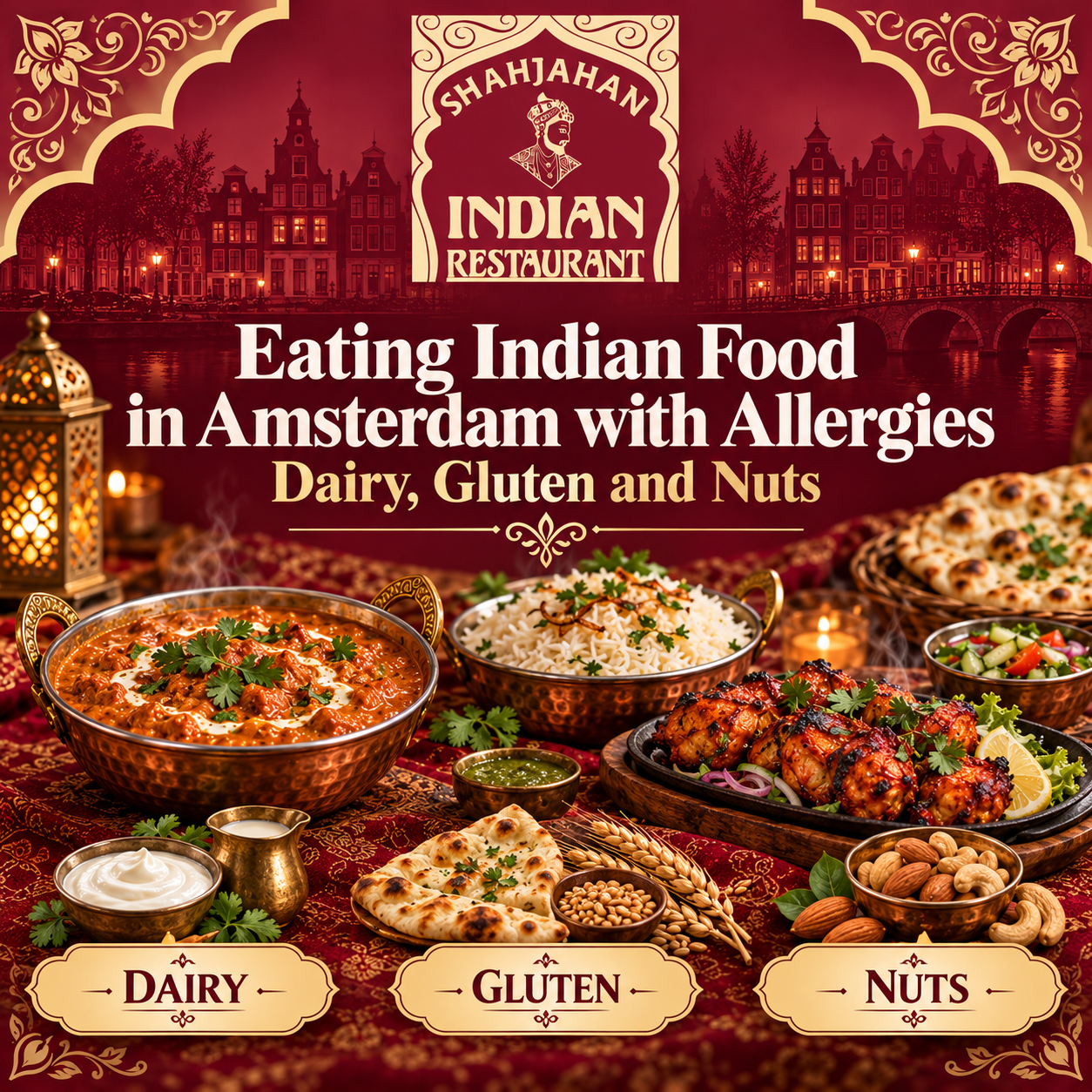
Eating out with a food allergy should feel like a treat, not a gamble. Indian cooking leans on dairy, wheat and nuts more than most cuisines, so a long curry menu can look like a minefield when you have to avoid one of them. The good news is that with a few clear questions, plenty of dishes can still work for you.
At Shah Jahan, our Indian restaurant in Amsterdam on Eerste Anjeliersdwarsstraat in the Jordaan, allergy questions come up at our tables every week. In this guide we share where dairy, gluten and nuts usually hide in Indian food, what our own menu tells you, and how to order safely whether you eat in or order at home.
Please note: this guide is general information, not medical advice. If you have a severe allergy, always speak to our team before you order.
Your rights: allergen information in Amsterdam restaurants
Before we get into the food, it helps to know where you stand. Since 13 December 2014, every restaurant in the Netherlands has had to inform guests about 14 allergens under EU Regulation 1169/2011. These are cereals containing gluten, egg, fish, peanuts, nuts, soy, milk (including lactose), crustaceans, molluscs, celery, mustard, sesame, sulphites and lupin.
According to the Netherlands Food and Consumer Product Safety Authority (NVWA), restaurants can give this information verbally, as long as guests know they can ask for it. One thing the law does not require is a warning about traces from shared equipment, which is exactly why we encourage you to ask about cross-contact as well as ingredients.
So the short version is simple: ask us. Our team can tell you which of the 14 allergens are in each dish. [CONFIRM WITH CLIENT: is a written allergen list or folder available for guests on request?]
Dairy: the most common allergen on an Indian menu
Dairy turns up in North Indian food in many forms: paneer (fresh cheese), cream, butter, ghee and yoghurt. It is part of what makes dishes like our famous butter chicken so rich, and it is also why dairy is the allergen we are asked about most.
Here is what our own menu shows:
- Tandoori starters: our Tandoori Mix starter and Prawn Tikka are listed as containing lactose, and so is the Mixed Grill.
- Fried starters: our samosas, butterfly prawns and paneer pakora contain lactose.
- Lentils: our Tarka Dal is made with Indian lentils cooked with butter.
- Creamy curries: our Lamb Kurma and Fish Kurma are cooked in a creamy sauce.
- Paneer dishes: palak paneer, paneer makhani and matar paneer are all built around homemade cheese.
- Breads: our paranta is a brown bread prepared with butter.
It also matters whether you have a milk allergy or lactose intolerance. They are not the same thing. People with lactose intolerance can often manage lactose-free dairy, while a true milk protein allergy can cause a serious reaction to any form of dairy, as the Center for Asthma and Allergy explains. Telling us which one you have helps us advise you properly.
If you avoid dairy, good places to start the conversation are our soups (dal soup, mulligatawny and yakhni), dishes cooked in a thick gravy such as our fish curry and lamb vindaloo, and plain rice. Please check with us first, as base sauces can still contain butter or ghee. [CONFIRM WITH CLIENT: which curries are made without butter, ghee, cream or yoghurt?]
One guest review even mentions our team making a vegan naan on request. [CONFIRM WITH CLIENT: can the kitchen still make a dairy-free naan?]
Gluten: easy to spot in bread, harder to spot in spices
The biggest gluten sources on any Indian menu are the breads. Naan, paranta and puri are all wheat breads, and on our menu the Chana Puri and Shrimp Puri starters are listed as containing gluten. Our onion bhajee is also made with wheat flour.
The less obvious source is a spice. Asafoetida, often called hing, comes from a plant resin that is naturally gluten-free, but most powdered hing sold commercially is blended with wheat flour to stop it clumping, as gluten-free specialists such as Zest and Zing point out. Some sauces can also be thickened with wheat flour, according to Anaphylaxis UK. If you have coeliac disease, ask us about both. [CONFIRM WITH CLIENT: is hing used, and is any curry thickened with flour?]
The good news is that rice is at the heart of so much Indian cooking. Swapping naan for rice is the simplest change you can make, and our dishes from the tandoor are served with rice and a vegetable curry sauce rather than bread. If you want to understand how that clay oven works, our guide from tandoor to table explains it.
Our chicken and paneer pakora are made with gram flour, which comes from chickpeas rather than wheat. Fried starters often share a fryer, though, so if you are coeliac, ask how they are cooked before you order. [CONFIRM WITH CLIENT: are pakora fried in the same oil as onion bhajee and samosa?]
Nuts: the allergen to take most seriously
Nuts deserve extra care. Almonds and cashews give many North Indian sauces their silky texture, and Anaphylaxis UK warns that curries may be thickened with peanut flour or ground almonds. The same charity reports that European registry data shows cashew is now a leading cause of anaphylaxis in children, while almonds are an unexpected risk in adults.
On our menu, nuts appear in some well-loved dishes:
- Almonds: our Lamb Kurma, Fish Kurma and Vegetable Kurma are cooked with coconut powder, almond, sugar and raisins.
- Cashews: our Chicken Hariyali is cooked in a sauce of spinach, mint and cashew nuts, and our Paneer Butter Masala uses cashew powder.
- May contain: our Mixed Grill is listed as possibly containing mustard and nuts.
Peanuts are legumes, not tree nuts, and many people react to one group and not the other. Tell us exactly which nuts you need to avoid and how severe your allergy is. Because nuts are used in our kitchen, we cannot promise any dish is completely free from traces. [CONFIRM WITH CLIENT: how the kitchen separates nut dishes, and the exact wording they want here]
If a member of staff anywhere ever seems unsure what is in a dish, Anaphylaxis UK’s advice is clear: don’t eat it. We would always rather you asked twice.
Our six-step checklist for ordering safely
- Tell us before you order. Mention your allergy as soon as you sit down, not when the food arrives.
- Be specific. Say whether it is a milk allergy or lactose intolerance, coeliac disease or a wheat preference, peanuts or tree nuts.
- Ask about the sauce, not just the dish name. Two curries with similar names can be built on very different bases.
- Ask about breads and the fryer. These are the two most common routes for gluten and cross-contact.
- Carry your medication. If you have an adrenaline auto-injector, bring it every time.
- When in doubt, choose something else. There is always another dish worth trying.
Set menus, sharing and ordering at home
Our set menus are a great way to try a bit of everything, but check the components first. Our Mumtaz Menu, for example, includes onion bhaji, chicken tikka masala, palak paneer, polao rice, naan and kheer, so it contains both dairy and gluten as standard. [CONFIRM WITH CLIENT: can dishes in set menus be swapped for allergies?]
Sharing plates is part of the fun of Indian food, so if one person at the table has a severe allergy, order their dishes separately and keep their serving spoons apart.
Ordering in? The same rules apply when you enjoy Indian takeaway at home. Add your allergy in the order notes when you order online, and for severe allergies, call us so we can talk it through. Our guide to ordering restaurant-quality curry for delivery has more tips.
Frequently asked questions
Is Indian food gluten-free?
Not automatically. Many curries are based on meat, vegetables, lentils and rice, but breads, some batters and powdered hing often contain wheat. Ask about each dish and swap bread for rice.
Can I eat Indian food with a nut allergy?
Often yes, but tell us first. Several of our dishes contain almonds or cashews, and nuts are used in our kitchen, so we will tell you which dishes contain them and talk you through the cross-contact risk.
Are there dairy-free Indian dishes?
Yes, many lentil, vegetable and meat curries can be lower in dairy, but butter, ghee and cream are common in North Indian sauces. Ask our team which dishes suit you before ordering.
Do restaurants in Amsterdam have to tell me about allergens?
Yes. Dutch law, based on EU Regulation 1169/2011, requires restaurants to tell you which of the 14 main allergens are in their food. They can do this verbally when you ask.
Can I order allergy-aware Indian takeaway in Amsterdam?
Yes. Add your allergy to the order notes and, for anything severe, call the restaurant before ordering.
Come and eat with us
An allergy should never stop you enjoying a proper North Indian meal. Browse our full menu, contact us with any questions before your visit, or find out why guests say our place is an Indian restaurant in Amsterdam worth visiting again and again. Looking for somewhere to book tonight? See our take on the best restaurants near me for dinner.
Tell us about your allergy when you arrive, and we will help you find something delicious.