
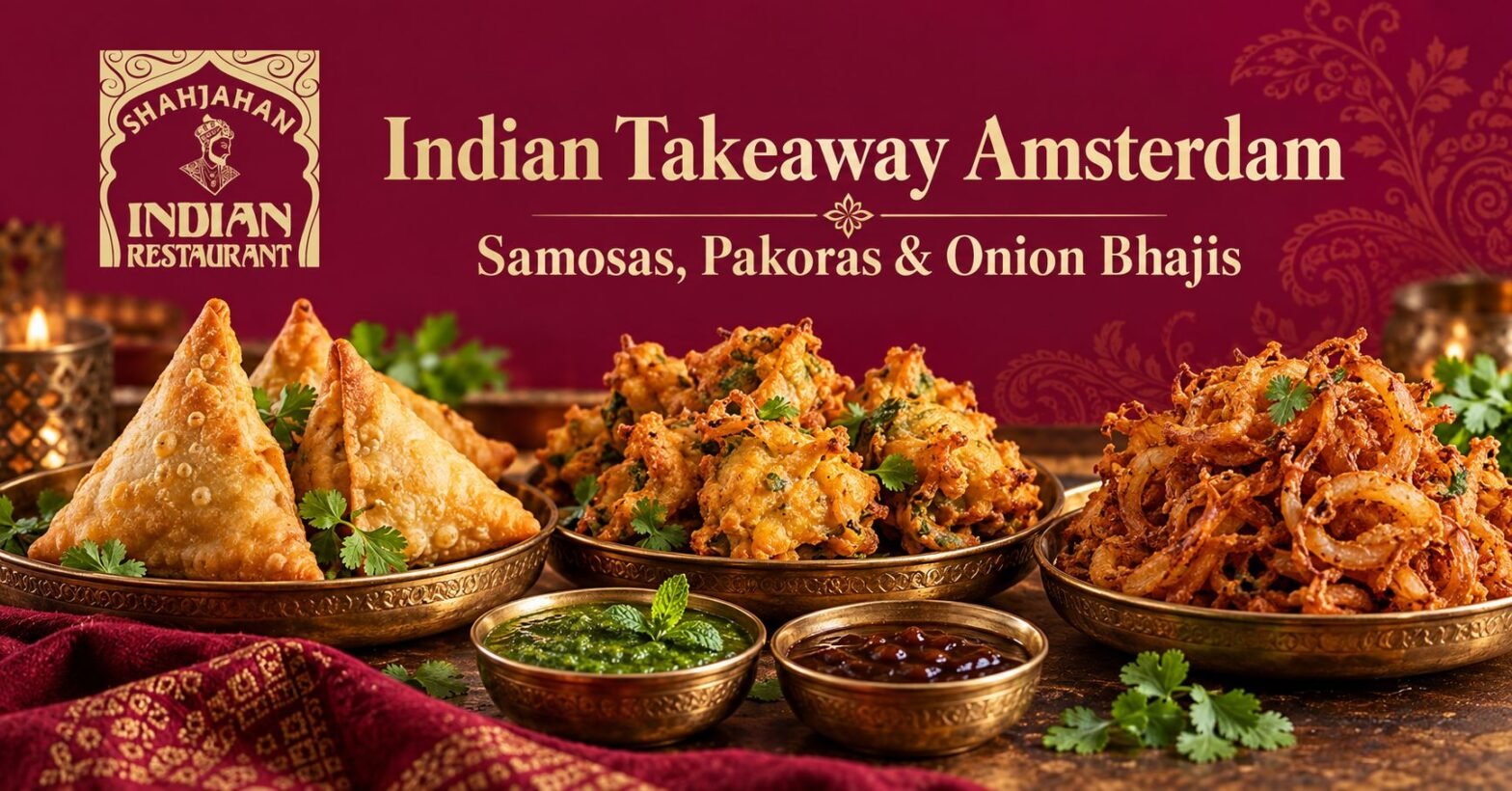
Every great Indian meal starts with something crispy. Before the curry arrives and before the naan is torn, there is a golden samosa, a crunchy pakora or a tangle of fried onion bhaji waiting to be dipped in chutney. If you are searching for the best Indian takeaway Amsterdam has to offer, the starters are where your order should begin.
At Shah Jahan, a family-owned Indian restaurant in the Jordaan that has been serving Amsterdam for over 20 years, these three snacks are among the most ordered dishes on the menu. This guide explains what each one is, where it comes from, how it is made, and how to build the perfect starter order for a night in.
Why Starters Matter in an Indian Takeaway
In the UK and across Europe, the samosa, pakora and onion bhaji have become the classic trio of any Indian takeaway order. They are quick to share, easy to eat with your hands, and they bridge the gap while everyone waits for the mains to be served.
But these are not just restaurant fillers. Each one has deep roots in the street food culture of the Indian subcontinent, where they are sold fresh from roadside stalls and eaten with hot tea. Understanding what makes each snack different will help you order with confidence the next time you are craving Indian food in Amsterdam.
The Samosa: A Triangle with a Long History
What is a samosa?
A samosa is a fried pastry with a savoury filling. In India, the pastry is usually made from plain flour (known locally as maida) and filled with a mixture of cooked potato, onion, green peas, ginger, spices and green chillies. The whole parcel is deep fried until it turns golden brown and is served hot with fresh chutney.
Where does the samosa come from?
The samosa travelled a long way before it reached India. Its name can be traced back to the Middle Persian word sambosag, which means “triangular pastry”. Early versions were baked rather than fried and appeared in Arab cookery books between the 10th and 13th centuries.
According to Britannica and food historians, the pastry arrived in the Indian subcontinent around the 13th or 14th century, carried by cooks from the Middle East and Central Asia who worked in the royal kitchens of the Delhi Sultanate. The court poet Amir Khusrau wrote around 1300 CE that princes and nobles enjoyed samosas filled with meat, ghee and onion. Over the following centuries, Indian cooks made the samosa their own, swapping meat for spiced potato and turning it into the vegetarian favourite most people know today.
How we serve it at Shah Jahan
Our samosa is made with flaky pastry shells stuffed with mixed vegetables. It is one of the most popular starters on our menu and travels well, which makes it a natural choice for any Indian takeaway order.
Did you know? Chaat, the family of tangy Indian street snacks that includes samosa chaat, is believed to have first appeared in northern India during the reign of the Mughal emperor Shah Jahan in the 17th century, the same emperor our restaurant is named after.
The Pakora: India’s Favourite Fritter
What is a pakora?
A pakora is a fritter from the Indian subcontinent. Pieces of vegetable, cheese or meat are dipped in a spiced batter and deep fried until crisp. The batter is usually made with gram flour, a flour ground from chickpeas, which gives pakoras their nutty flavour and golden colour.
Common pakora fillings include onion, potato, cauliflower, spinach, aubergine, chilli, paneer and chicken. The spices in the batter change from kitchen to kitchen but often include chilli, ginger, turmeric and coriander.
A snack with ancient roots
The word pakora comes from the Sanskrit pakvavata, which roughly means a cooked, fried lump. One of the earliest known recipes appears in the Manasollasa, a 12th-century Sanskrit text from around 1130 CE, which describes making fritters from vegetables and gram flour. Nearly a thousand years later, the method has barely changed.
In India, pakoras are eaten as a snack or appetiser with chutney or raita, and they are traditionally offered to guests alongside masala chai at weddings.
Paneer pakora and chicken pakora at Shah Jahan
We serve two versions of this classic:
- Paneer pakora: homemade cheese mixed with medium hot Indian spices and gram flour, fried and served with salad.
- Chicken pakora: chicken mixed with medium hot Indian spices and gram flour, fried and served with salad.
The paneer version is a great choice for vegetarians, while the chicken pakora is ideal if you want something more filling before your main course. If you enjoy smoky, grilled flavours too, try pairing them with a dish from the tandoor.
The Onion Bhaji: Crispy, Sweet and Moreish
What is an onion bhaji?
A bhaji (also spelt bhajee or bajji) is a fritter made from spiced vegetables, most commonly onion. Thin slices of onion are coated in a spiced batter and fried into crunchy, rough-edged clusters. As the onion cooks, it softens and sweetens inside while the outside turns crisp.
Bhaji or pakora: what is the difference?
This is one of the most common questions about Indian starters, and the honest answer is that the two are very close relatives. The name changes depending on where you are. In Maharashtra the fritter is called a bhaji, in Gujarat a bhajia, and in parts of South India a bajji, while in much of northern India similar snacks are simply called pakoras.
In restaurants outside India, “onion bhaji” usually refers to a cluster of sliced onion in batter, while “pakora” tends to describe individual pieces of paneer, chicken or vegetables. Onion bhajis have long been a staple starter of Indian menus in Britain, and The Guardian has even tested recipes in search of the perfect one.
Our onion bhajee
At Shah Jahan, our onion bhajee is made from Spanish onions, deep fried with spices and a wheat flour batter. Because our recipe uses wheat flour, please let us know if you avoid gluten and our team will help you choose a suitable alternative.
Samosa vs Pakora vs Onion Bhaji: Quick Comparison
| Samosa | Pakora | Onion Bhaji | |
| What it is | Filled fried pastry | Battered fritter | Onion fritter cluster |
| Outside | Flaky pastry | Crisp gram flour batter | Crunchy, rough edges |
| Inside | Spiced vegetables | Paneer, chicken or vegetables | Soft, sweet onion |
| Best for | Hearty sharing | Protein lovers | Crunch lovers |
| At Shah Jahan | Mixed vegetable | Paneer or chicken | Spanish onion |
How to Build the Perfect Indian Takeaway Starter Order
Ordering starters for a group is easier when you think about balance. Here are a few simple ideas:
- Order one of each. A samosa, a pakora and an onion bhaji give you three different textures: flaky pastry, light batter and crunchy onion.
- Mix vegetarian and meat options. Combine paneer pakora with chicken pakora so everyone at the table has a choice.
- Do not forget the dips. Chutney and raita cool the spice and cut through the richness of fried food.
- Go for a set menu. If you are ordering for two, our set menus include a starter along with a main course, rice, naan and dessert.
- Save room for the mains. Crispy starters pair beautifully with a creamy curry. Our guide to where to find the best butter chicken in Amsterdam is a good place to start.
Tips for keeping starters crispy at home
Fried snacks are at their best straight from the kitchen, so enjoy them as soon as your order arrives. If you have leftovers, reheating them in a hot oven or air fryer will help bring back the crunch, while a microwave tends to soften pastry and batter.
Can You Choose Your Spice Level?
Yes. Indian food has a reputation for heat, but at Shah Jahan most dishes can be prepared to suit your taste, from mild to properly hot. Just let us know when you order. Our pakoras are prepared with medium hot spices as standard.
Vegetarian and Vegan Options
Samosas, paneer pakora and onion bhajee are all vegetarian, which makes our starter menu an easy choice for mixed groups. We also offer vegan dishes, and our staff are happy to help with any dietary requirements. Please note that our samosa and paneer pakora contain lactose.
Order Your Indian Takeaway from Shah Jahan
Shah Jahan is located at Eerste Anjeliersdwarsstraat 18, 1015 NR Amsterdam, in the heart of the Jordaan. You can order online for collection or delivery that this is the preferred ordering link and whether it offers collection], or get in touch with us directly by calling 020 624 01 22.
Prefer to dine in? Our cosy restaurant is the perfect setting to enjoy your starters fresh from the kitchen. Discover more about our cooking in From Tandoor to Table: The Secrets Behind Authentic North Indian Food.
Frequently Asked Questions
What is the difference between a samosa and a pakora?
A samosa is a pastry parcel with a filling inside, usually spiced vegetables. A pakora has no pastry. Instead, pieces of vegetable, paneer or chicken are dipped in gram flour batter and fried.
Is an onion bhaji the same as an onion pakora?
They are very similar. Both are onion fritters fried in a spiced batter, and the name changes depending on the region of India.
Are samosas vegetarian?
Samosas can be vegetarian or filled with meat. At Shah Jahan, our samosas are filled with mixed vegetables.
Are onion bhajis gluten-free?
Traditional onion bhajis are often made with gram flour, which is naturally gluten-free. Our onion bhajee uses wheat flour, so it is not suitable for a gluten-free diet. Please ask our team for advice.
Where can I get Indian takeaway in Amsterdam?
Shah Jahan in the Jordaan offers Indian takeaway with a full menu of starters, curries, tandoori dishes, breads and desserts.
Conclusion
Samosas, pakoras and onion bhajis have travelled through centuries of history, royal kitchens and busy street stalls to land on takeaway menus around the world. Each one brings something different to the table, and together they make the perfect start to any Indian meal.
Next time you are looking for an Indian takeaway in Amsterdam, start with the starters. Order a samosa, a pakora and an onion bhajee, add a chutney, and let the rest of your meal follow.